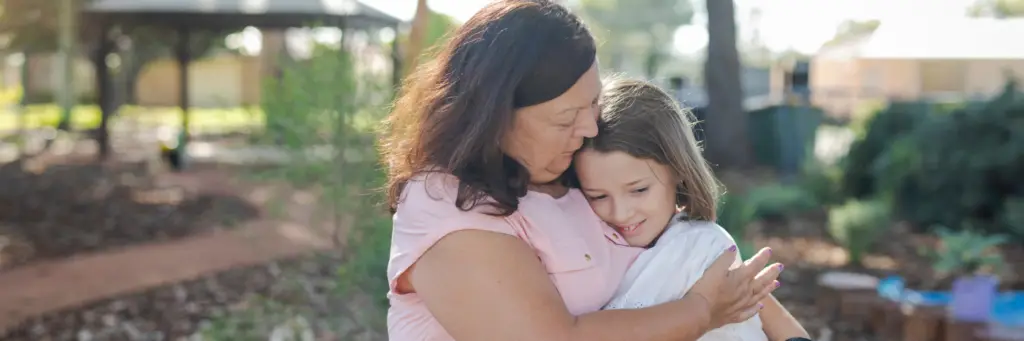
Grandparents raising grandchildren, and what it costs them
Tonight, thousands of children in Western Australia will go to bed in the home they share with their grandparents — grandparents who are responsible for their full-time care. Children come into a grandparent’s care when it is unsafe for them to live with their parents, usually because of substance use, mental health issues, incarceration or domestic violence, and with that comes trauma and grief for both grandparents and grandchildren.
Grandparent care is the fastest growing form of out-of-home care for vulnerable children in Australia. It keeps children out of the foster care system, and the evidence shows children in kinship care do better in health and education, with more stable placements, than children in foster care. Yet grandparent carers are largely hidden — absent from research, service and government data, and lost inside policy frameworks that cross multiple jurisdictions.
To change that, Wanslea (now Uplyft) led a three-year, cross-institutional research project with Edith Cowan University and Curtin University, funded by Lotterywest: a state-wide survey of 622 grandparent carers, interviews and focus groups with service providers, and a mapping of the State and Federal policy and legislation they navigate. A Fairer Future for Grandchildren is what it found.
A selfless decision
“A grandparent who takes on the primary care of their grandchildren, often under complex and traumatic family circumstances, is making a selfless decision to prioritise their grandchild’s safety and wellbeing.”
“Many face challenges in securing the income they need to support the children in their care, to resolve legal issues and in accessing services such as counselling, health care and education … Grandparent carers deserve our admiration and need our full support to undertake this vital role.”
— Colin Pettit, Commissioner for Children and Young People
The grandparents and the children in their care
The grandchildren had lived with their grandparents for 6.3 years on average; 12 per cent for longer than ten years, and one in five came into care aged a year or less. Half came into care because of a parent’s alcohol or drug use. More than 30 per cent have a high-needs mental health issue, and every child in the study had at least one adverse health condition.
- 77 per cent of grandparent carers are aged 50 to 69, and in 70 per cent of families the grandmother is the primary or sole carer.
- 77 per cent are informal carers — a private family arrangement, not an authorised placement.
- 66 per cent live below the poverty line; 44 per cent are single, most often women.
- They raise 2.5 grandchildren on average — Aboriginal grandparent carers one to two more than that.
Five things the research made clear
- Trauma, love and joy intersect. Grandchildren come into a grandparent’s care for reasons that create trauma; grandparents find satisfaction and joy in giving them safety, security and love.
- Health impacts occur across every dimension of a grandparent’s health — social, physical, mental, emotional and financial. They are worse off than others their age.
- Aboriginal grandparent carers experience specific challenges of poverty and service exclusion, while also enjoying a higher degree of satisfaction and support from their social network.
- Navigating systems is complex and inequitable. Service and legal systems neither recognise nor respond to their unique needs, and informal carers are shut out of universal services by their lack of legal recognition.
- Poverty is entered into, or made worse, when grandparents take responsibility for their grandchildren — changing their employment, finances and housing to do it.
Living below the line
Two-thirds of the grandparent carers surveyed live below the poverty line, on under $50,000 a year, and one in six exists on less than $19,000. Formal carers receive a foster care subsidy, yet there is almost no difference between formal (65 per cent) and informal carers (66 per cent) living in poverty — while raising larger families than the Australian average, often with children whose experiences of trauma call for specialist support.
Nearly half changed their employment to take on the care: cutting hours, becoming unemployed or retiring early. A quarter changed their housing, some taking on debt or drawing down superannuation to do it. One in five receives no financial support at all from family or government, and fewer than a quarter receive State-based support such as the foster carer subsidy — for which informal carers are ineligible.
“I enjoy being a grandparent but it’s really hard for me to pay my bills and living expenses. I need to have repairs to my car but because of the difficulties in my house I am not able to do it.”
— Grandparent carer, survey participant
Keeping children safe in culture
Aboriginal grandparent carers are over-represented among grandparent-headed families and under-represented in services. Of the carers living on less than $19,000 a year, 80 per cent identified as Aboriginal; they are more likely to be single, in social housing, and to have gone without enough to eat. They care for more children — 3.5 on average — and tend to be younger.
They are also less likely to seek services, for reasons with deep historical roots in fear and distrust of child welfare authorities, and they frequently fall through gaps because Aboriginal kinship naming does not fit the Western paradigm. Yet they report more help from their family and social networks, better emotional wellbeing, and markedly higher satisfaction in the caring role. In Western Australia an Aboriginal child is 18 times more likely to be in out-of-home care than a non-Aboriginal child; culturally safe, place-based services and fair income support are essential to sustaining kinship placements that keep children safe in culture.
“I teach them about our Aboriginal culture and the importance of knowing who they are and where they fit within our families. To know culture is to accept identity.”
— Grandparent carer, survey participant
A toll on every dimension of health
Using a standardised health assessment, the survey compared grandparent carers with the general Australian population of the same age. Across every group — formal and informal, Aboriginal and non-Aboriginal — carers scored lower on every dimension, and roughly 25 per cent lower than community norms for emotional health, social health and bodily pain. Two-thirds live with an existing medical condition, and nearly half said it interferes with their ability to care.
“That it is relentless — there is never, NEVER, EVER, EVER a break. That I am worn down, I cannot recuperate. That I cannot rest if I am tired or ill.”
— Grandparent carer, survey participant
The demands of the role play their part, but so does poverty — the link between the two is well known. Grandparent carers need the financial and material resources to maintain their health as they age.
Satisfaction, and the fear of what comes next
Despite the hardship, 76 per cent of grandparent carers said they were satisfied in the role. What they enjoyed most was giving their grandchildren safety and security, followed by mutual love and joy, and the closeness of the relationship. Their greatest worry was the future of their grandchildren should their own health fail — and the relentless, tiring, unsupported day-to-day of care.
“He has shown me a new world full of unconditional love and unending joy … he is the reason I get up in the morning and I thank God for entrusting him to my care.”
— Grandparent carer, survey participant
What needs to change
For grandchildren to keep flourishing in the consistency, security and love grandparent care gives them, the report calls on State and Commonwealth governments, service providers and the Western Australian community to act on six things:
- A State-based subsidy payment for all grandparent carers, formal and informal.
- Reforms to how Family Tax Benefit is paid.
- Access to legal services.
- Robust service data, so carers are counted.
- Coordinated policy responses across child protection, health, education, income support and housing.
- An evidence-of-care system that gives informal carers recognition.
Care for grandparent carers is care for children. Read the full report below.